Differential forms
In continuum mechanics, the most general form of an exact conservation law is given by a continuity equation. For example, conservation of electric charge q is
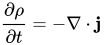
where ∇⋅ is the divergence operator, ρ is the density of q (amount per unit volume), j is the flux of q (amount crossing a unit area in unit time), and t is time.
If we assume that the motion u of the charge is a continuous function of position and time, then

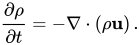
In one space dimension this can be put into the form of a homogeneous first-order quasilinear hyperbolic equation:

where the dependent variable y is called the density of a conserved quantity, and A(y) is called the current jacobian, and the subscript notation for partial derivatives has been employed. The more general inhomogeneous case:

is not a conservation equation but the general kind of balance equation describing a dissipative system. The dependent variable y is called a nonconserved quantity, and the inhomogeneous term s(y,x,t) is the-source, or dissipation. For example, balance equations of this kind are the momentum and energy Navier-Stokes equations, or the entropy balance for a general isolated system.
In the one-dimensional space a conservation equation is a first-order quasilinear hyperbolic equation that can be put into the advection form:

where the dependent variable y(x,t) is called the density of the conserved (scalar) quantity (c.q.(d.) = conserved quantity (density)), and a(y) is called the current coefficient, usually corresponding to the partial derivative in the conserved quantity of a current density (c.d.) of the conserved quantity j(y):

In this case since the chain rule applies:

the conservation equation can be put into the current density form:
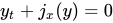
In a space with more than one dimension the former definition can be extended to an equation that can be put into the form:

where the conserved quantity is y(r,t), denotes the scalar product, ∇ is the nabla operator, here indicating a gradient, and a(y) is a vector of current coefficients, analogously corresponding to the divergence of a vector c.d. associated to the c.q. j(y):


This is the case for the continuity equation:

Here the conserved quantity is the mass, with density ρ(r,t) and current density ρu, identical to the momentum density, while u(r,t) is the flow velocity.
In the general case a conservation equation can be also a system of this kind of equations (a vector equation) in the form:

where y is called the conserved (vector) quantity, ∇ y is its gradient, 0 is the zero vector, and A(y) is called the Jacobian of the current density. In fact as in the former scalar case, also in the vector case A(y) usually corresponding to the Jacobian of a current density matrix J(y):
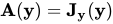
and the conservation equation can be put into the form:

For example, this the case for Euler equations (fluid dynamics). In the simple incompressible case they are:
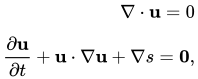
where:
- u is the flow velocity vector, with components in a N-dimensional space u1, u2 ... uN,
- s is the specific pressure (pressure per unit density) giving the source term,
It can be shown that the conserved (vector) quantity and the c.d. matrix for these equations are respectively:

where denotes the outer product.

Comments
Post a Comment